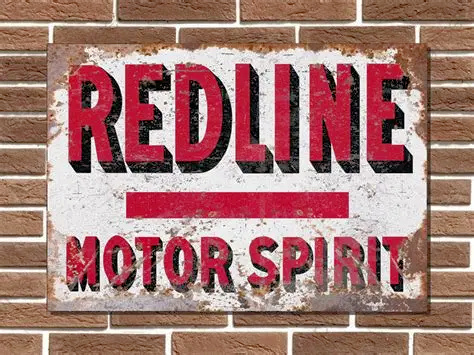
Redline information and advert image courtesy of Mike Barnsley.
The Control Office was open 24 hours a day and there were three of us on each shift, the District Controller himself, the so-called 'Loco Man' whose main job was to juggle with freight train drivers' and guards' 'turns' as they were called so as to ensure that they were used as efficiently as possible while keeping them within their allotted hours. And bottom of the heap was the Junior Controller of whom I was one.
Virtually all our work was concerned with keeping freight services running on the main line (passenger trains being dealt with by our parent Control Office in Bristol) and we rarely if ever had any contact with the M&SW line which was more or less left to run itself.
That said, I had long been interested in the M&SW and took every opportunity to visit the line and some of the people, especially signalmen, who worked there.
For example, one in Swindon Town 'A' box which controlled the north end of the station and therefore the southern end of the single line from Rushey Platt. I remember him explaining that over time the single line tokens would gravitate towards the Rushey end and would occasionally need to be rebalanced. This was because, if a down train needed to have a bank engine, the Swindon Town pilot engine would be sent as a Light Engine to Rushey Platt using one token.
However, only a single token would be used for the return train even though there would be two locomotives hauling it with the result that there would be an extra token at Rushey Platt each time this happened.
I was especially friendly with one of the guys at Swindon Town 'B' box who often regaled me with usually funny, although sometimes lewd, stories of what he and his colleagues had done, notably but only, during the war years.
His father, an out and out GWR man, had worked at Savernake Low Level station and was mortified when his son on leaving school chose to take up employment with the despised rival Midland and South Western Railway. "I liked the dark red trains," he told me, "They seemed more exotic and came and went to and from places I had never heard of."
Over the next few years I was to travel the whole length of the line several times, albeit in different stages.
I particularly remember my last ever trip. It was on Thursday, 7 September 1961, two days before the line closed for good. I had got up early to catch the train from Swindon Town to Cirencester and was somewhat surprised to see it standing it what was called the 'Up Middle Road', i.e. one track away from the 'Up Relief' platform. The one station staff member present asked if he should ask the driver to put the train into the platform for me. I told him this wasn't necessary, climbed off the platform onto the track, and walked over to the train before hauling myself up into the carriage immediately behind the engine.
A few minutes later the guard came up to the engine signalling that he wanted to speak.
"The brake van's at the other end, Harold," came the witty response.
"We got a passenger," Harold informed them to their surprise.
"Where's he going? We'd better ask him."
"Cirencester." I told them.
"That's OK. It means we won't have stop on the way."
On arrival at Cirencester the firemen came to my window to explain they didn't normally put the train into the platform but would do so if I wanted to get off there. When I told him that I was only there for the ride he seemed greatly relieved.
After a few moments the engine ran around and the train reversed back down the line to Swindon Town by which time things had become a great deal more efficient.
I realised afterwards early morning train to Cirencester must have been the one that had been mandated by the 1923 Grouping in order to provide a service for former M&SWJR staff at the Cirencester works and whose jobs had been transferred to the giant GWR works at Swindon.
One thing that always intrigued me was the next bus stop after Broome Manor Lane on the way into Old Town. This stop alongside the corrugated iron fence beside the old M&SWJR engine shed was known as 'Red Line' but no one could ever tell me why. One person thought it was because a red line had been painted along the corrugated fence during the war. I even had the fanciful idea it might have been a reference to the Midland Red M&SW trains as opposed to the chocolate and cream GWR ones although I admit that was unlikely. Does anyone know why that stop was called 'Red Line'?
p.s. Perhaps it relates to Redline Motor Spirit, who took over the old MSWJR shed.
Redline information and advert image courtesy of Mike Barnsley.